Observem os seguintes pares de frases, em Português:
Par 1:
a - Ele tem muitos livros.
b - Tem uma pessoa esperando por você.
Par 2:
a - Minha mulher leva minha filha para a escola todo dia.
b - Ela leva uma hora para ler o jornal.
São frases bem simples, bem naturais, usadas normalmente em Português que cerca de 90% das pessoas traduzem as frases B de modo errado, como se fossem iguais às frases A.
O que muita gente não consegue assimilar rapidamente são duas construções que fogem à tradução ap pé da letra: IT TAKES e as variações do verbo THERE TO BE..
No par número 1, na primeira frase temos realmente o verbo HAVE para o verbo TER em Português, pois trata-se de posse.
Então, Ela tem muitos livros = She has many books.
Já na segunda frase, este verbo TER em Português não representa posse, e sim EXISTÊNCIA, e não podemos usar HAVE e sim o verbo THERE TO BE.
Entâo, Tem uma pessoa esperando por você = There is a person waiting for you e não Have a person waiting for you. Frases erradas como esta aparecem em quase todas as redações. Cuidado, pois.
Assim como usamos there is, usaremos da mesma forma todas as outras variações do verbo there to be: there are, there was, there were, there will be, there have been, there has been e por aí vai.
E o outro par de frases nos mostra o verbo levar como conduzir, na primeira frase, e como levar tempo, na segunda.
Na primeria - Minha mulher leva minha filha para a escola todo dia. = My wife takes my daughter to school every day.
Temos que ter cuidado na segunda.
Ela leva uma hora para ler o jornal NÂO É She takes one hour to read the newspaper e sim IT TAKES HER one hour to read the newspaper. Observe que usamos HER e não she pois o sujeito é e sempre será IT.
Logo, ao mencionarmos duração de tempo, temos esta estrutura especial: IT TAKES.
Outros exemplos:
Eles levam 30 min para almoçar = It takes THEM 30 minutes to have dinner.
Eu levei uma hora para terminar o dever = It took me one hour to finish my homework.
sábado, 3 de setembro de 2011
Quando usar Do/ Does ou verbo TO BE ?
A primeira coisa que devemos ter em mente é que o verbo to be (traduzido em 99% dos casos por SER e ESTAR) é um verbo que deve ser estudado à parte e normalmente não entra nas estruturas que são aplicadas a outros verbos.
Vamos lá: uma frase bem bobinha: She is Brazilian. Como vamos mexer com esta frase na negativa ? Simples, só acrescentando NOT ao verbo, que pode ou não vir abreviado.
Temos então: She is not Brazilian ou She isn´t Brazilian.
E para perguntas é só invertermos o TO BE com o sujeito da frase, ou seja, ele virá antes:
Is she Brazilian ?
Outros exemplos, agora usando o plural:
Afirmação - They are nice people.
Negativa - They aren´t nice people.
Pergunta - Are they nice people.
Usamos a mesma estrutura ao mencionarmos ações em andamento. A única diferença agora é que teremos, além do TO BE, um outro verbo, SEMPRE com ING.
Afirmação - She is watching TV.
Negativa - She isn´t watching TV.
Pergunta - Is she watching TV ?
Viram como é igual, como é fácil ?
Agora uma coisa MUITO IMPORTANTE: em uma oração em que haja verbo TO BE nunca existirá o auxiliar DO (ou sua variação DOES) e vice versa.
DO e DOES são auxiliares. Ora bolas, o que é isso ? Exatamente o que o nome diz. Se eles são auxiliares, eles auxiliam os verbos nas frases ( nâo esqueçam, qualquer verbo menos o verbo to be ).
E ao contrário do verbo to be que aparece sempre, eles não aparecem em afiramtivas. Apenas em perguntas e negativas.
Pergunta - Do you speak English ? (Esta é a estrutura básica de perguntas no presente simples em Inglês, que é AUXILIAR + SUJEITO + VERBO + COMPLEMENTO)
Afirmação - I speak English
Negação - I don´speak English.
E a variação DOES usamos para qualquer sujeito singular com exceção de I e YOU.
Does she speak English ?
She speaks English. (não podemos esquecer de conjugar o verbo em afirmações)
She doesn´t speak English.
As 100 palavras mais escritas de forma errada em inglês.
| acceptableaccidentally accommodate acquire acquit a lot amateur apparent argument atheist believe calendar category cemetery changeable collectible committed conscience conscientious conscious definite(ly) disappear discipline drunkenness embarrass | equipment exhilarate exceed existence experience fiery foreign fourth gauge generally grammar grateful guarantee harass height hierarchy ignorance immediate independent indispensable intelligence its / it's judgement knowledge leisure | librarylightning maintenance manoeuvre memento millennium miniature mischievous noticeable occasion occasionally occur / occurred occurrence official parallel parliament pastime pigeon possession preferable principal / principle privilege questionnaire receive recommend | referredreference relevant religious restaurant ridiculous rhythm sandal schedule scissors sensible separate special success to / too / two tomorrow their / they're / there twelfth tyranny until vacuum vicious weather weird you're / your |
quarta-feira, 31 de agosto de 2011
Safety Tips.
Flight attendants that are on duty according to the schedule are to perform demonstrations regarding the safety precautions in case of emergency.Passengers are to be informed appropriately and the instructions given should bevery organized. This is to ensure the passengers boarding the plane understand the instructions and carry out them if necessary.
Flight attendants in the process of demonstrating the instructions should also bear in mind, the appropriate way of communicating and bringing themselves in a public situation.
Difficult situations on the plane.
In a flight, there are a variety of passengers and flight attendants have to take this matter into account. Passengers are never easy to be satisfied. What should you do in handling difficult situations? What if something goes wrong in the plane?
Passengers in the plane will be looking for you in case of emergency for your guidance and instruction. In such situations, you must not portray any sort of fear or discomfort and this is very much needed because if you did, the passengers would get panicked and the situation might get worse. You must show that you are confident in that role and that you have the utmost faith in your pilots and your aircraft, and that you know exactly what you are doing and why you need to do it. Smile and comfort them efficiently.
Different ways are to implied with different passengers – age factor comes into the picture in this context. Grammar and the word choices also play a part.
Below are some techniques that you can perform in case of emergency.
- Ask yourself questions when you have to deal with passengers and keep in mind these questions need to be answered within a few seconds - Who are they? Why do you think they are complaining or not cooperating? How will you resolve the situation? What language will you use?
- Use of apologetic language may soften the situation.
- Imply politeness strategy while communicating with the passengers.
Yes, flight attendants play a very important role. Remember the things that you should do in case of emergency! Do not panic.
Aviation vocabulary
| Word | Meaning | Example of sentence |
| airfare noun | cost of a plane ticket | The cost of your meal is covered in your airfare. |
| aisle noun | the long empty space that you walk down | Please keep your bags out of the aisle so that nobody trips. |
| aisle seat noun | the seat that is next to the aisle | I’ll give you an aisle seat in case you need to walk around with the baby. |
| assist verb | help | Please wait until everyone is off the plane so that we canassist you. |
| baggage noun | the bags and suitcases that travellers put their belongings in | I’m afraid your baggage got on the wrong airplane. |
| baggage, luggage claim noun | place where you pick up your baggage after arrival | The announcement will direct you to the correct baggage claim. |
| blanket noun | warm covering | If you feel cold I can get you ablanket. |
| boarding pass noun | part of the ticket that you give to the crew as you step onto the plane | Your must present yourboarding pass at the gate. |
| bumpy, rough adj | up and down movement of the aircraft | It might be a bumpy ride because we are flying through a storm. |
| cabin noun | interior of the aircraft | There is no smoking allowed inside the cabin. |
| call light noun | a button passengers can press to get a crew member’s attention | If you need anything, just press the call light. |
| captain noun | the person who is in charge of the plane | Would the kids like to go and meet the captain? |
| charter noun | discount airline | If you take a charter it will cost you half as much. |
| cockpit noun | the part of the plane where the captain and his co-pilots sit | We aren’t doing any more tours of the cockpit because it’s almost time to land. |
| comfortable adjective | feel good physically, able to relax | Because you have long legs you might be morecomfortable in an aisle seat. |
| complimentary adjective | free of charge | We offer complimentarycoffee or tea, but you have to pay for alcohol. |
| co-pilot noun | person who helps the captain fly the plane | If the captain gets sick the co-pilot can take over. |
| domestic adjective | within the same country | You should be at the airport two hours ahead of time fordomestic flights. |
| emergency exit noun | section of the plane that opens in the case of an accident | Are you comfortable sitting next to the emergency exit? |
| e-ticket noun | airfare purchased on the internet | You will need to present your identification along with youre-ticket. |
| excess baggage noun | heavier/more bags than you are allowed | You can either pay for yourexcess baggage or leave one of your bags behind. |
| first-class noun/adj | more expensive seating, with better services | When you sit in first-classyou get a better meal to eat. |
| gate noun | place where passengers go to wait to board a plane | Gate 3B is down this hall and to your right. |
| headset, earphones noun | device that allows passengers to listen to music or a movie | We will be coming around to sell headsets for five dollars. |
| international adj | worldwide | For international departures, go up one level. |
| jet lag noun | tiredness due to travelling through different time zones | I’m used to travelling now. My body doesn’t suffer from jet lag anymore. |
| land verb | returning to the ground after being in the air | We will be landing in Tokyo in approximately ten minutes. |
| life vest, life jacket noun | a blow-up device that you put on in an emergency over water | Please take a moment to locate the life vest under your seat. |
| motion sickness noun | a bad feeling in the stomach that passengers get during a rough ride | There is a paper bag in front of you in case you experiencemotion sickness. |
| overbooked adj | more passengers than available seats | The flight is overbooked. Four of our passengers will have to wait for the next flight. |
| overhead bin/compartment noun | place above the seats for storing luggage | You’ll have to put your bag under your seat because all of the overhead bins are full. |
| over-sized baggage adj | items that do not fit in suitcases | Infant car seats and sporting equipment can be picked up at the over-sized baggagecounter. |
| oxygen mask noun | a device that goes over a person’s face, provides air in case of cabin air pressure loss | Put your oxygen mask on first before putting one on your child. |
| passport noun | document that proves a person’s identification and nationality | Please have your passportout when you go through security. |
| pilot noun | the person who drives the plane | The pilot is circling over the airport until it is safe to land. |
| refreshments noun | drinks and snacks | It’s a short flight, so we will be serving refreshments but not a meal. |
| row noun | a number of seats beside each other | You are in seat B of row nine. |
| runway noun | the strip of land that an airplane takes-off and lands on | The plane almost missed therunway because it was such a bad storm. |
| seatbelt noun | device that holds passengers in their seats | Please remain in your seats while the seatbelt light is on. |
| steward (male), stewardess (female), flight attendant, air host noun | man or woman who provides service for passengers during a flight | Ask one of the stewardessesfor a pillow if you’re tired. |
| stopover noun | touching down at more than one airport during a flight | It’s not a direct flight. We’re making one stopover in Toronto. |
| take off noun/verb | when the plane leaves the ground | We are next in line to take offon this runway. |
| taxi in, out verb | driving an airplane to the correct place for taking off or deboarding | Please remain in your seats until we taxi in to the gate. |
| touch down verb, noun | when the aircraft wheels land on the ground | That was a very smooth touch down. |
| turbulence noun | rough flight | This turbulence should only last a few minutes. |
| wheelchair noun | a seat for pushing elderly, disabled, or injured people | A steward will take you to the gate with a wheelchair. |
| window seat noun | seat next to the window where passengers can look out | If your child wants a window seat I can move you back a row. |
View some of the pictures here! All of the pictures cannot be included here due to the nature of the words involved.
Understanding Flight Attendants...
What do you understand about flight attendants? Are you aware of the nature of the job? What are the responsibilities involved? Well, if you want to know the answer, continue reading!
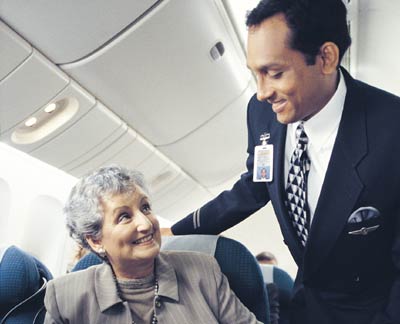
Flight attendants are referred to as a community of people that are responsible in ensuring the passengers’ comfort and safety at all times. Flight attendants, sometimes called as the members of the cabin crew not only take charge of the passengers’ well doing but also to make sure the plane boards and departs at the given schedule.
Besides maintaining the routine tasks, flight attendants also grant the passengers’ request and deal with their queries while providing a good service to them and these includes delivering food items, providing comforters and etcetera. Among others, flight attendants should adhere to the safety and security of the travelling at all times. Flight attendants should also try to make flights comfortable and enjoyable for passengers.
Flight attendants are briefed by the captain at least an hour before the take off. Here, they are exposed to emergency evacuation procedures, coordination of the crew, the length of the flight, expected weather conditions, and special issues having to do with passengers.
Being the flight attendant, you must make sure that first-aid kits and other emergency equipment are aboard and in working order and that the passenger cabin is in order, with adequate supplies of food and other necessities. As passengers board the plane, you have to greet them, check their tickets, and tell them where to store carry-on items. Do not forget to portray a smile!
Before the plane takes off, you have to instruct all passengers in the use of emergency equipment and check to see that seatbelts are fastened, seat backs are in upright positions, and all carry-on items are properly stowed. In the air, helping passengers in the event of an emergency is the most important responsibility of a flight attendant.
Any queries about the flight should be answered appropriately. In certain cases you must also take into account other minor responsibilities that are involved and these include: distribute reading material, pillows, and blankets; and help small children, elderly or disabled persons and any others needing assistance.
What about the working hours? Please take note of this as this is very important for you. Flight attendants may have to work nights, holidays, and weekends. Theworking hours are not fixed and you are to adhere to these rules and regulations at all times. Attendants usually fly 65 to 90 hours a month and generally spend another 50 hours a month on the ground preparing planes, writing reports, and waiting for planes to arrive.
Flight attendants receive extra compensation for increased hours. Flight attendants may be away from their home base at least one-third of the time. During this period, the airlines provide hotel accommodations and an allowance for meal expenses. Wow, this is so fun! You get to spend your time in a hotel while you are on work!
You should always bear in mind that you must be flexible and willing to relocate yourself if you were asked to do so. However, many flight attendants elect to live in one place and commute to their assigned home base. Home bases and routes worked are bid for on a seniority basis. This simply means to say that the longer you have been employed, the more likely you are able to work on chosen flights. Almost all flight attendants start out working on reserve status or on call. On small corporate airlines, flight attendants often work on an as-needed basis and must adapt to varying environments and passengers.
The combination of free time and discount airfares provides flight attendants the opportunity to travel and see new places. However, the work can be strenuous and tiring. You have to stand most of the time and this can be really exhausting! You have to remain pleasant and efficient, regardless of how tired they are or how demanding passengers may be. Occasionally, flight attendants must deal with disruptive passengers.
Working in a moving aircraft leaves flight attendants susceptible to injuries. For example, back injuries and mishaps can occur when opening overhead compartments or while pushing heavy service carts. In addition, medical problems can arise from irregular sleeping and eating patterns, dealing with stressful passengers, working in a pressurized environment, and breathing recycled air. This is not provided here to discourage you but just as a kind note. Bear in mind the pressures and responsibilities.
All sorts of jobs around the world have some form of pressures; and it is your responsibility to deal with them. Work without stress and you will love your job!
Managed to understand them all? Great! The next section looks at the structural patterns of communication in English. Acknowledge the different approaches involved in the communication aspect. Have fun!
Assinar:
Postagens (Atom)