quinta-feira, 26 de janeiro de 2012

Present Perfect

FORM

[has/have + past participle]
Examples:
  • You have seen that movie many times.
  • Have you seen that movie many times?
  • You have not seen that movie many times.

USE 1 Unspecified Time Before Now

We use the Present Perfect to say that an action happened at an unspecified time before now. The exact time is not important. You CANNOT use the Present Perfect with specific time expressions such as: yesterday, one year ago, last week, when I was a child, when I lived in Japan, at that moment, that day, one day, etc. We CAN use the Present Perfect with unspecific expressions such as: ever, never, once, many times, several times, before, so far, already, yet, etc.
Examples:
  • have seen that movie twenty times.
  • I think I have met him once before.
  • There have been many earthquakes in California.
  • People have traveled to the Moon.
  • People have not traveled to Mars.
  • Have you read the book yet?
  • Nobody has ever climbed that mountain.
  • A: Has there ever been a war in the United States?
    B: Yes, there has been a war in the United States.

How Do You Actually Use the Present Perfect?

The concept of "unspecified time" can be very confusing to English learners. It is best to associate Present Perfect with the following topics:

TOPIC 1 Experience

You can use the Present Perfect to describe your experience. It is like saying, "I have the experience of..." You can also use this tense to say that you have never had a certain experience. The Present Perfect is NOT used to describe a specific event.
Examples:
  • have been to France.
    This sentence means that you have had the experience of being in France. Maybe you have been there once, or several times.
  • have been to France three times.
    You can add the number of times at the end of the sentence.
  • have never been to France.
    This sentence means that you have not had the experience of going to France.
  • I think I have seen that movie before.
  • He has never traveled by train.
  • Joan has studied two foreign languages.
  • A: Have you ever met him?
    B: No, I have not met him.

TOPIC 2 Change Over Time

We often use the Present Perfect to talk about change that has happened over a period of time.
Examples:
  • You have grown since the last time I saw you.
  • The government has become more interested in arts education.
  • Japanese has become one of the most popular courses at the university since the Asian studies program was established.
  • My English has really improved since I moved to Australia.

TOPIC 3 Accomplishments

We often use the Present Perfect to list the accomplishments of individuals and humanity. You cannot mention a specific time.
Examples:
  • Man has walked on the Moon.
  • Our son has learned how to read.
  • Doctors have cured many deadly diseases.
  • Scientists have split the atom.

TOPIC 4 An Uncompleted Action You Are Expecting

We often use the Present Perfect to say that an action which we expected has not happened. Using the Present Perfect suggests that we are still waiting for the action to happen.
Examples:
  • James has not finished his homework yet.
  • Susan hasn't mastered Japanese, but she can communicate.
  • Bill has still not arrived.
  • The rain hasn't stopped.

TOPIC 5 Multiple Actions at Different Times

We also use the Present Perfect to talk about several different actions which have occurred in the past at different times. Present Perfect suggests the process is not complete and more actions are possible.
Examples:
  • The army has attacked that city five times.
  • have had four quizzes and five tests so far this semester.
  • We have had many major problems while working on this project.
  • She has talked to several specialists about her problem, but nobody knows why she is sick.

Time Expressions with Present Perfect

When we use the Present Perfect it means that something has happened at some point in our lives before now. Remember, the exact time the action happened is not important.
Sometimes, we want to limit the time we are looking in for an experience. We can do this with expressions such as: in the last week, in the last year, this week, this month, so far, up to now, etc.
Examples:
  • Have you been to Mexico in the last year?
  • have seen that movie six times in the last month.
  • They have had three tests in the last week.
  • She graduated from university less than three years ago. She has worked for three different companies so far.
  • My car has broken down three times this week.

NOTICE

"Last year" and "in the last year" are very different in meaning. "Last year" means the year before now, and it is considered a specific time which requires Simple Past. "In the last year" means from 365 days ago until now. It is not considered a specific time, so it requires Present Perfect.
Examples:
  • went to Mexico last year.
    I went to Mexico in the calendar year before this one.
  • have been to Mexico in the last year.
    I have been to Mexico at least once at some point between 365 days ago and now.

USE 2 Duration From the Past Until Now (Non-Continuous Verbs)

With Non-Continuous Verbs and non-continuous uses of Mixed Verbs, we use the Present Perfect to show that something started in the past and has continued up until now. "For five minutes," "for two weeks," and "since Tuesday" are all durations which can be used with the Present Perfect.
Examples:
  • have had a cold for two weeks.
  • She has been in England for six months.
  • Mary has loved chocolate since she was a little girl.
Although the above use of Present Perfect is normally limited to Non-Continuous Verbs and non-continuous uses of Mixed Verbs, the words "live," "work," "teach," and "study" are sometimes used in this way even though they are NOT Non-Continuous Verbs.

ADVERB PLACEMENT

The examples below show the placement for grammar adverbs such as: always, only, never, ever, still, just, etc.
Examples:
  • You have only seen that movie one time.
  • Have you only seen that movie one time?

ACTIVE / PASSIVE

Examples:
  • Many tourists have visited that castle. Active
  • That castle has been visited by many tourists. Passive

segunda-feira, 16 de janeiro de 2012

13 Dicas para aumentar seu vocabulário inglês

1 – Faça imagens das palavras que você quer aprender. O cérebro funciona por meio de imagens; a prova disso é que você sonha imagens e não palavras. Portanto, se transformar em imagens as palavras a serem aprendidas, você ajuda seu cérebro a aprendê-las mais rapidamente. Veja este Picture Dictionary para ajudar em suas ilustrações.

a kiss for you i love you 13 dicas para aumentar seu vocabulário inglês
Kiss for you, I love you
2 – Cole etiquetas nos objetos de sua casa ou escritório. O vocabulário mais fácil de aprender é aquele que está relacionado às coisas que você usa e vê diariamente. Numa tira de papel, escreva a palavra inglesa a ser aprendida. Em seguida, cole essa tira no objeto correspondente (use fita adesiva). Veja aqui a lista de móveis e eletrodomésticos em inglês no Visual Webster Dictionary. Deixe as etiquetas coladas nos objetos por alguns dias ou semanas, até você ter aprendido todo o vocabulário.
3 – Faça marcações em fotos. Se você não pode etiquetar os objetos de seu escritório, tire uma foto de seu local de trabalho, imprima a foto e faça setas apontando para os objetos que você vê na foto. Na extremidade da seta, escreva a palavra inglesa correspondente. Depois que dominar esse vocabulário, faça o mesmo com fotos dos lugares por onde você passa diariamente (metrô, cinema, restaurante, museu, supermercado, campo de futebol, etc.). Monte seu próprio dicionário inglês ilustrado. Veja exemplos nosInfo Visual e Photographic Dictionary
4 – Aprenda palavras por tema. Por exemplo: móveis de uma sala, lista de frutas, partes de um carro, etc. Palavras de um mesmo grupo ajudam o cérebro a criar elos entre elas com mais facilidade.
5 – Faça lista de vocabulário inglês – inglês. Crie listas de sinônimos (high-tall) e de antônimos (good-bad). A ligação entre os sinônimos e os antônimos facilita a memorização.
6 – Aprenda o vocabulário de filme. Nos filmes, o vocabulário é sempre repetitivo. Por isso, ao ver na legenda alguma palavra inglesa desconhecida, faça uma pesquisa rápida no dicionário. Da próxima vez que a palavra pesquisada aparecer, você não só vai entendê-la mas também vai fixar essa palavra na mente. Deixe um dicionário próximo ao seu televisor.
7 – Mude o idioma de seus equipamentos para o inglês. No menu de configuração de seu celular, mude o idioma para inglês. Isso fará com que você tenha contato com esse idioma diariamente. Altere também o idioma de seu DVD, sistema operacional do computador, etc.
8 – Aprenda formação de palavras em inglês. Usos de prefixos e sufixos aumentam seu vocabulário rapidamente e de maneira muito fácil. O sufixo ER, por exemplo, é acrescentado a verbos para formar substantivos (wash (lavar) – washER (lavador)). Veja lista de prefixos e sufixos ingleses aqui.
9 – Aprenda as palavras que pesquisou em seu dicionário eletrônico. Geralmente os dicionários eletrônicos registram as 20 ou 30 últimas palavras pesquisadas. Reveja essa lista com regularidade até dominar esse conteúdo.
10 – Faça flash-cards para memorizar novas palavras. Os flash-cards garantem o aprendizado mais rápido de qualquer lista de palavras. Para saber mais sobre eles, clique em Como memorizar palavras estrangeiras rapidamente
11 – Aprenda “collocations” – “Collocations” são palavras que sempre ou quase sempre estão juntas tais como go togethergo homehave dinner. Veja mais exemplos de collocations.
12- Compre livro de aumento de vocabulário. Esses livros apresentam palavras por tema e trazem exercícios para reforçar o aprendizado.
13 – Aprenda palavra inglesa diariamente. Existem sites que enviam palavras inglesas com explicação e exemplos para seu email todos os dias. Ler as mensagens ajuda a aumentar seu vocabulário. Alguns sites que fazem isso são Webster DictionaryOxford Dictionary e, claro, nosso queridíssimo Inglês no Supermercado.
Fonte: Inglês no Supermercado

domingo, 25 de dezembro de 2011

Christmas Vocabulary ( in English).

Christmas Vocabulary


advent


the arrival of someone or something important
Adventthe coming (or second coming) of Jesus Christ; the month leading up to Christmas
angela spiritual being acting as a messenger of God (usually shown as a human being with wings)
berrya small round fruit
Bethlehemthe small town in the Middle East believed to be the birthplace of Jesus Christ
candlea cylinder of wax with a central wick (like string) which burns to produce light
chimneya vertical pipe in a house that allows smoke and gases to escape from a fireplace (Father Christmas traditionally enters a house through its chimney)
Christthe title of Jesus (also used as His name)
Christiana person who believes in Christianity; also an adjective
Christianitythe religion based on the teachings and person of Jesus Christ
Christmasthe annual Christian festival celebrating the birth of Jesus Christ (Christmas Day is on 25 December)
Christmas cakea rich fruit cake covered with white icing, eaten at Christmas
Christmas carda greetings card that people send to friends and family at Christmas
Christmas carola religious song or popular hymn that people sing at Christmas
Christmas Day25 December, the birthday of Jesus Christ
Christmas Evethe evening or day before Christmas Day (24 December)
Christmas holidaysthe holiday period for about a week before and after Christmas Day
Christmas presenta gift or present given at Christmas
Christmas treean evergreen tree (often a spruce) that people decorate with lights and ornaments at Christmas
crackera decorated paper tube that makes a sharp noise ("crack!") and releases a small toy when two people pull it apart
decorationsomething that adds beauty; ornament
egg-noga traditional Christmas drink made of alcohol with beaten eggs and milk
Father Christmasan imaginary being who brings presents for children on the night before Christmas Day (also known as Santa Claus) - traditionally an old man with a red suit and white beard
fireplacea partly enclosed space in a house where people light a fire for warmth
frankincensea gum used for incense, one of the gifts that the three wise men gave to Jesus
golda yellow precious metal, one of the gifts that the three wise men gave to Jesus
hollyan evergreen plant with prickly dark green leaves and red berries
Jesusthe name of Christ, the central figure of Christianity (believed by Christians to be the Son of God)
Josephthe husband of Mary (the mother of Jesus)
magithe wise men from the East who brought gifts for the baby Jesus
mangera trough for food for horses or cattle (used by Mary as a cradle or bed for Jesus)
Marythe mother of Jesus
mistletoea parasitic plant with white berries, traditionally used as a Christmas decoration
myrrha gum used for perfume or incense, one of the gifts that the three wise men gave to Jesus
nativitythe birth of a person
the Nativitythe birth of Jesus Christ
nativity playa play that people perform at Christmas based on the birth of Jesus
new yearthe start of a year; the period just before and after 1 January
New Year's Day1 January
New Year's Eve31 December
ornamentan object that adds beauty to something; a decoration
presenta thing given to somebody as a gift.
reindeera deer with large antlers found in some cold climates (believed to pull the sleigh for Santa Claus or Father Christmas)
Santa Clausan imaginary being who brings presents for children on the night before Christmas Day (also known as Father Christmas) - traditionally an old man with a red suit and white beard (Santa Claus may be based in part on the historical figure of Saint Nicholas.)
shepherda person who looks after sheep
sleigha sledge or light cart on runners pulled by horses or reindeer over snow and ice
snowwater vapour from the sky that falls as white flakes and covers the ground
stara bright point in the night sky which is a large, distant incandescent body like the sun
the star of Bethlehemthe star that announced the birth of Jesus and guided the wise men to find Him
tinsela decoration consisting of thin strips of shiny metal foil, traditionally used at Christmas
turkeya bird like a large chicken, traditionally eaten at Christmas
white Christmasa Christmas with snow on the ground
Xmasabbreviation or informal term for Christmas

Christmas Expressions

  • Merry Christmas!
  • Happy Christmas
  • Happy New Year!
  • Merry Christmas and a Happy New Year!
  • Wishing you a prosperous New Year
  • All the best for the coming year
  • Seasons Greetings!

Vocabulário de Natal


1. Christmas tree: Árvore de natal.
Ex: There was a beautiful Christmas tree in the living room. (Tinha uma bonita árvore de natal na sala.)
2. Christmas ornaments: Decorações de natal.
Ex: They’re going to get the Christmas ornaments. (Elas vão buscar as decorações de natal.)
3. Nativity scene: Presépio.
Ex: The Nativity scene is part of the celebrations. (O Presépio faz parte das celebrações.)
4. Father christmas/Santa Claus: Papai noel.
Ex: Children often dream about Santa Claus. (As crianças muitas vezes sonham com o papai noel.)
5. Sleigh: Trenó
Ex: They saw a sleigh on tv. (Eles viram um trenó na tv.)
6. Turkey: Peru
Ex: She said she’s never eaten turkey. (Ela disse que nunca comeu peru.)
7. The star of Bethlehem: A estrela de Belém.
Ex: They’re talking about the star of Bethlehem. (Estão falando da estrela de Belém.)
8. Fireplace: Lareira
Ex: There was a fireplace in their house. (Havia uma lareira na casa deles.)
9. Christmas carol: Cântico natalino
Ex: It reminds me of that Christmas carol. (Isto me faz lembrar daquele cântico natalino.)
10. Merry Christmas/happy christmas: Feliz natal
Ex: Merry christmas! (Feliz natal!)
11. Xmas: Natal. (Abreviação de Christmas.)
12. Christmas gift: Presente de natal.
Ex: They got a Christmas gift.(Eles ganharam um presente de Natal.)
13. Christmas Eve: Véspera de Natal.
Ex: They made it up on Christmas Eve. (Fizeram as pazes na Véspera do Natal.)

terça-feira, 6 de dezembro de 2011

VERBOS MODAIS


Os verbos modais são verbos distintos dos outros, pois possuem características próprias, como:
  1. Não precisam de auxiliares;
  2. Sempre após os modais, o verbo deve vir no infinitivo, só que sem o “to”;
  3. Não sofrem alteração nas terceiras pessoas do singular no presente. Logo, eles nunca recebem “s”, “es” ou “ies”.
São verbos modais: can (pode), could (poderia), may (pode, poderia), might(pode, poderia), should (deveria), must (deve), ought to (precisa) e used to(costumava).
Can: pode ser usado para expressar permissão, habilidade.
Can I drink water? (Posso beber água?).
I can speak English. (Eu posso falar inglês).
Could: é empregado para expressar habilidade, só que no passado. É usado também com o sentindo de poderia, em um contexto mais formal.
I could ride a bike when I was 5 years old. (Eu podia/conseguia andar de bicicleta quando tinha 5 anos de idade).
Could you bring me a sandwich and a coke, please? (Você poderia me trazer um sanduíche e uma coca, por favor?).
May: é usado para expressar uma possibilidade no presente ou no futuro. Também pode ser usado para pedir permissão, no entanto, may é usado em contextos mais formais que o can.
It may rain tomorrow. (Pode chover amanhã).
May I go to the bathroom? (Eu poderia ir ao banheiro?).
Might: é usado para expressar possibilidades no passado ou no presente.
She might have come to the party. (Ela poderia ter vindo à festa).
He might have lunch with us tomorrow. (Ele pode vir almoçar com a gente amanhã).
Should e ought to: é usado para expressar um conselho.
You should go to the doctor. (Você deveria ir ao médico).
You ought to quit smoking. (Você deveria parar de fumar).
Must: é usado para expressar obrigação.
You must go to school. (Você deve ir à escola).
She must study more. (Ela deve estudar mais).
Used to: é empregado para expressar um hábito do passado.
I used to watch cartoons when I was a child. (Eu costumava assistir desenhos quando era criança).
She used to play on the street when she was 8 years old. (Ela costumava brincar na rua quando tinha 8 anos de idade).

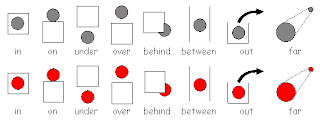
Como utilizar preposições em inglês? Regras simples.


Em inglês, temos, dentre outras, as seguintes preposições: “at”, “on”, “in”, cujo emprego pode ser utilizado, via de regra:


Em se tratando de LUGAR, regra geral, “on” significa “sobre”, “in” quer dizer “dentro” e “at” acaba sendo aplicado para os demais casos.

Ex1: The book is on the table

(O livro está sobre a mesa)


The book is in the box

(O livro está dentro da caixa)


You can find the book at the library

(Você pode achar o livro na biblioteca)


The sign is at the door

(O aviso está na porta)


Alice is at home 

(Alice está em casa)


Em se tratando de TEMPO, regra geral, “on” é utilizado para dias e datas, “in” para períodos (de meses, anos, etc.) e “at” para horas.


Ex2: See you on Monday

(Te vejo na segunda) 


Sheila will be back on your birthday

(Sheila estará de volta no seu aniversário)


Life was better in the 70’s

(A vida era melhor nos anos setenta)


Rita will buy a car in a couple of months

(Rita comprará um carro em dois meses)


Paul is arriving at nine o’clock

(Paul está chegando às nove horas)


Luch will be served at noon

(O almoço será servido ao meio-dia)


See you at night

(Te vejo à noite)


To e For 


Preposições são palavras de significado pouco claro e muito variável. São mais partículas funcionais do que palavras de conteúdo semântico definido. A maioria das ocorrências de preposições, não segue um padrão lógico ou regular. Além disso, entre o português e o inglês, as preposições não apresentam uma correlação muito estreita. Cobrem normalmente diferentes áreas de significado, sendo umas de uso mais amplo que outras.

É particularmente notória a dificuldade para nós, brasileiros, quando temos que decidir qual preposição usar em inglês, to ou for, quando em português a idéia seria expressa através da preposição para. Em geral, pode-se dizer que to está ligado à idéia de direção, movimento, correspondendo muitas vezes também à preposição a do português; enquanto que for está relacionado com a idéia de substituição, intenção ou predestinação, correspondendo, às vezes, ao português por. Esta diferença de significado, entretanto, não é sempre clara. Mesmo assim, for e to raramente podem ser usados como sinônimos.

Freqüentemente to e for introduzem o objeto indireto e é neste caso que as duas preposições normalmente correspondem ao português para. Objeto indireto em inglês é sempre um nome ou pronome que precede ou sucede o objeto direto nos verbos bitransitivos. Quando posicionado antes do objeto direto, não vem acompanhado de preposição. Quando posicionado após o objeto direto, virá invariavelmente acompanhado da preposição to ou for. Neste caso, a preposição certa dependerá do verbo, não havendo regra para isso. Observe os seguintes exemplos:

TO VERBS     /       FOR VERBS 
I gave a present to him. = I gave him a present.
I'll show the figures to you. = I'll show you the figures.
He sold a car to me. = He sold me a car.
He sent a letter to Mary. = He sent Mary a letter.
Can you lend this book to me? = Can you lend me this book?
The boss told a joke to us. = The boss told us a joke.
Who teaches English to them? = Who teaches them English?
I paid $10 to the repairman. = I paid the repairman $10.
Will you pass the sugar to me? = Will you pass me the sugar?
Read a story to the children. = Read the children a story.
I wrote a letter to my friend. = I wrote my friend a letter.
Hand that book to me, please. = Hand me that book, please.
He offered a job to Mary. = He offered Mary a job.
He'll bring something to me. = He'll bring me something.
She sang a lullaby to the baby. = She sang the baby a lullaby.
I'll throw the ball to you. = I'll throw you the ball. Let me buy a present for you. = Let me buy you a present.
I got some food for you. = I got you some food.
She made a sandwich for me. = She made me a sandwich.
Did she cook dinner for you? = Did she cook you dinner?
Can you do a favor for me? = Can you do me a favor?
He can find a job for you. = He can find you a job.
He left a message for you. = He left you a message.
Shall I pour more tea for you? = Shall I pour you more tea?
Reserve hotel rooms for us. = Reserve us hotel rooms.
Save the stamps for him. = Save him the stamps. 

Existem também verbos que só aceitam o objeto indireto quando acompanhado de preposição. Exemplos:

TO VERBS  /   FOR VERBS 
The teacher said "Good morning" to the students.
He's going to introduce Mary to his family.
I already explained the project to the staff.
Mr. Cole described the new house to his wife.
I sometimes speak English to (with) my wife.
Bob reported the accident to the police.
I repeated your ideas to my parents.
He admitted his mistake to the boss.
I'll mention your plan to the director.
Dr. Bishop recommends this medicine to some patients.
Richard has announced his engagement to his friends.
It sounds good to me.
The salesgirl suggested a gift to Philip. Can you carry the suitcases for me?
Could you open the door for me?
He asked the bank teller to cash a check for him.
Doctors like to prescribe medicine for the patients.
She is going to prepare the meal for the guests.
I asked her to sign the letter for me.
Can you hold this for me, please?
I changed the traveler's checks for you.
I asked the secretary to make an appointment for me.
He translated an article for me.
I recorded a tape for you.
I'll take the car to the mechanic for you.
The salesgirl suggested Philip a gift for his girlfriend.
Can you play the piano for me? 

Na verdade, quase qualquer verbo aceita o adjunto preposicional for. São portanto ilimitadas as possibilidades de FOR VERBS neste segundo grupo. Observe-se que mesmo os TO VERBS, além de aceitarem o objeto indireto precedido pela preposição to, também aceitam o adjunto preposicional for, porém com outro sentido.

Ex:

I sent a letter to Mary.
I sent a letter for Mary.

No primeiro exemplo, Mary mora noutro lugar e eu lhe escrevi mandando notícias. No segundo exemplo, Mary escreveu uma carta para alguém, estava talvez muito ocupada para ir ao correio, e eu fui em lugar dela.

O verbo to go também freqüentemente ocorre associado às preposições to e for. Observe-se os dois grupos abaixo:

GO TO EXPRESSIONS     /     GO FOR EXPRESSIONS 
go to work
go to school
go to bed
go to church
go to town
go to court
go to pieces
go to hell
go to Porto Alegre
go to the bank, go to the office, etc. go for a walk 
go for a ride 
go for a drive 
go for a beer 
go for it 

Uma das ocorrências mais elementares da preposição to é no uso do infinitivo em inglês. Isto normalmente ocorre na estrutura VERB + to + VERB. Exemplos:

I have to go.
I like to drink beer.
Nice to meet you.
I'm not able to work.
He decided to leave.
He helped me to find my keys.
We expect to win the game.
Mesmo quando não introduzem objetos indiretos, a ocorrência das preposições to e for continua dependendo do verbo que acompanham ou da expressão idiomática em que ocorrem. Em muitos casos for corresponde a por do português. Exemplos:

TO EXPRESSIONS       /      FOR EXPRESSIONS 
Up to date
To my surprise, ...
To the best of my knowledge, ...
According to ...
Apply to a university.
He reacted well to my comments.
I object to staying up late.
I'm accustomed to working hard.
I'm not used to working on Sundays.
It's very sensitive to cold weather.
To (for) me, it sounds good.
It's interesting to me.
She was invited to a party.
I'm looking forward to hearing from you.
It's a hundred miles from here to Porto Alegre.
They raised his salary to $1,000.
Don't jump to conclusions. For sure!
For God's sake!
For example, ...
For this reason ...
For the first time ...
For (to) me, it sounds good.
Apply for a job.
Any letters for me?
I feel sorry for them.
He left for home.
He works for a tobacco company.
I sold my house for 40 thousand dollars.
He charged 50 dollars for the translation.
I lived abroad for 7 years.
He's very strong for an old man.
I'm looking for a job.
He received a grant for studying medicine.
I want eggs for breakfast.
I wrote a check for $100.